Not every greenhouse belongs on a balcony.
Apartment balconies have real limitations —
space, weight capacity, wind exposure, drainage, and sometimes building restrictions.
Choosing the wrong setup can lead to wasted money, unstable shelving,
overheated plants, or frustrated neighbors.
Before you buy or build anything,
here’s exactly what to look for in a balcony greenhouse
so it actually works in a small-space environment.
👉 If you’re starting from scratch, see our guide on
How To Build A Balcony Greenhouse For Small Spaces for layout ideas
and beginner-friendly setups.
Why Balcony Greenhouses Require Different Consideration
Balcony greenhouses aren’t the same as backyard setups.
You’re working with limited square footage, elevated exposure to wind,
shared drainage systems, and structural weight limits that don’t exist in ground-level gardens.
That means choosing a greenhouse isn’t just about size or price —
it’s about fit, safety, and long-term practicality.
Before you focus on features or style, start with the fundamentals below.
👉 If you’re curious about me, you can read more here —
but you’re in the right place if you just want to learn something useful.
Balcony Size & Layout
Start with measurements.
Measure:
-
Width
-
Depth
-
Door swing clearance
-
Railing height
-
Walking space you want to preserve
A greenhouse that technically “fits” but blocks your walkway or door isn’t practical long term.
Corner units work well on narrow balconies.
Vertical shelf-style units maximize limited depth.
Full-wall lean-to styles work best on deeper balconies.
Weight & Structural Safety
This is where most guides fall short.
Soil is heavy.
Wet soil is heavier.
Shelving adds more load.
Water runoff adds stress.
Balconies are designed for typical furniture loads —
not concentrated garden weight in one corner.
Look for:
-
Lightweight shelving frames
-
Even weight distribution
-
Avoiding solid heavy wood bases on upper floors
-
Controlled drainage systems
If you’re unsure about weight limits, check your building guidelines before committing.
Wind Exposure
Higher floors mean stronger wind.
Plastic-covered greenhouses can act like sails.
Lightweight frames can shift or tip if not reinforced.
Look for:
-
Reinforced corner joints
-
Crossbars for stability
-
Anchor or tie-down points
-
Heavier bottom shelves
Compact greenhouse kits with reinforced metal frames generally perform better on
apartment balconies than ultra-light PVC-only frames.
Sunlight Direction
Sun exposure determines plant success.
South-facing balconies get the most consistent light.
East-facing receive gentle morning sun.
North-facing often require supplemental lighting.
Before choosing a greenhouse:
-
Observe sun patterns for several days
-
Check for overhang shadows
-
Consider seasonal light shifts
If direct sunlight is limited,
make sure your greenhouse allows room for supplemental grow lighting.
Frame Material
Different materials behave differently in apartment settings.
PVC Frames
-
Lightweight
-
Affordable
-
Easy to modify
-
Less stable in wind
Metal Frames
-
Durable
-
Better for windy balconies
-
Powder-coated options resist rust
-
Moderate weight
Wood Frames
-
Attractive
-
Customizable
-
Heavier
-
Better suited for ground-level balconies
For most apartment environments,
reinforced metal-frame greenhouse kits offer the best balance between
stability and manageable weight.
Cover Type
The cover affects insulation, durability, and wind resistance.
Clear Polyethylene Covers
-
Lightweight
-
Affordable
-
Zippered access
-
Can degrade over time
Reinforced Greenhouse Film
-
Stronger tear resistance
-
Better for windy conditions
Polycarbonate Panels
-
Rigid
-
Excellent insulation
-
Longer lifespan
-
Heavier
If wind exposure is a concern,
reinforced covers or polycarbonate panels are typically better long-term choices.
Ventilation & Drainage
Balconies can trap heat.
Without airflow, humidity builds quickly and mold becomes a real problem.
Look for:
-
Roll-up zippered doors
-
Mesh ventilation panels
-
Adjustable openings
-
Space for a small clip fan
Also consider water runoff.
Your balcony should allow drainage without pooling or leaking onto neighbors below.
Power Access & Lighting Compatibility
If you plan to grow year-round, power access matters.
Check:
-
Is there a safe outdoor-rated outlet?
-
Can you run an extension cord safely?
-
Is there shelf space for an LED grow light?
Compact LED grow lights designed for shelving systems work best in
balcony greenhouse setups without overwhelming limited space.
Recommended Balcony Greenhouse Options
Once you’ve evaluated your space,
here are three common setups that work well for small balconies:
Best for Narrow Balconies
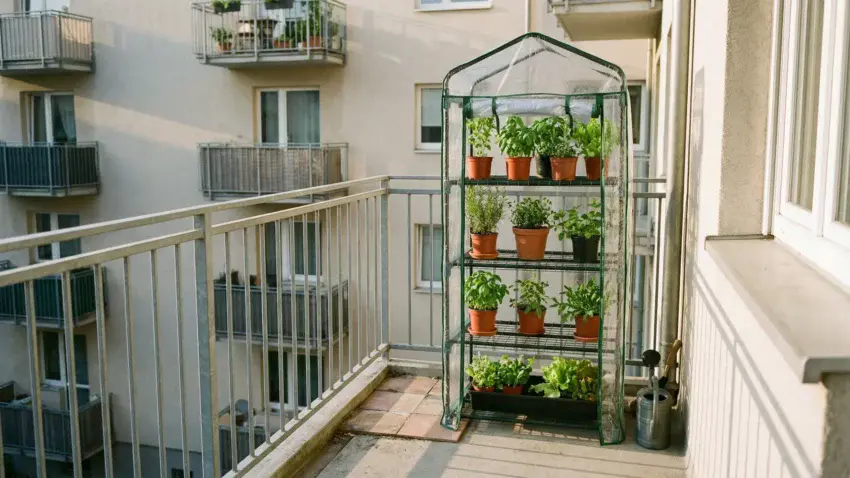
Compact 4-tier zippered greenhouse kits with reinforced metal frames.
These maximize vertical growing space without taking up much floor area.
 Amazon Product Suggestion:

 Small Plastic 4-Tier Greenhouse with Durable PE Cover
A practical option for narrow balconies where space and weight matter.
The slim metal frame keeps the load manageable,
while the reinforced PE cover helps protect plants from light wind and retain warmth.
Four vertical shelves maximize growing space without taking up much floor area.
Why it’s great:
✔ Lightweight frame
✔ Slim footprint
✔ Reinforced cover
✔ Vertical growing space
Best for Windy Apartment Balconies
Polycarbonate panel mini greenhouse kits with rigid framing.
More durable and stable in high-rise environments.
Amazon Product Suggestion:

MCombo 2-Tier Wooden Cold Frame Greenhouse with Polycarbonate Panels
A solid choice for balconies that need more wind resistance
and insulation than soft-cover kits provide.
The wood frame adds stability, while the polycarbonate panels help retain heat
and protect plants in cooler conditions.
Its compact footprint works well on deeper balconies where added weight is manageable.
Why it’s great:
✔ Rigid frame for added stability
✔ Polycarbonate panels improve insulation
✔ Compact cold-frame design
✔ Adjustable ventilation via opening top
Best for DIY Flexibility
Heavy-duty metal shelving paired with reinforced greenhouse covers.
This allows custom sizing while keeping weight manageable.
Amazon Product Suggestion:

56×56×78-Inch Mini Walk-In Greenhouse with Steel Shelves
A better fit for larger or deeper balconies where extra height is available.
The steel frame and shelving provide added stability,
while the thick PE cover helps retain warmth and reduce light wind exposure.
This style works well for gardeners who want
more vertical clearance for taller plants.
Why it’s great:
✔ Walk-in height for taller plants
✔ Steel frame for added durability
✔ Thick PE cover for basic insulation
✔ Roll-up door for easy access and airflow
👉 Learn how to properly heat, ventilate, and light a balcony greenhouse
to keep plants healthy year-round.
I didn’t figure this stuff out on my own —
I followed a step-by-step system that made everything finally click.
👉 If you’re curious how I actually learned this,
I break it down here.
Helpful Guides For Choosing The Right Balcony Greenhouse
Choosing the right balcony greenhouse involves more than just
finding one that fits your space.
Things like materials, airflow, plant selection, and sunlight exposure all affect
how well your greenhouse performs throughout the year.
If you want to explore these important factors in more detail,
the guides below break down the key elements that help balcony greenhouses thrive.
👉 Best Materials For Balcony Greenhouses
Learn which frame materials and coverings provide the best durability, insulation,
and protection for balcony setups.
👉 Best Plants For A Balcony Greenhouse
Discover herbs, vegetables, and compact plants that grow
especially well in small balcony greenhouses.
👉 How Much Sun Does A Balcony Greenhouse Need
Understand how sunlight affects plant growth and
how to position your greenhouse for the best results.
👉 Balcony Greenhouse Ventilation Tips
See how proper airflow helps control humidity, prevent disease,
and keep plants healthy inside small greenhouse spaces.
Final Thoughts…
A balcony greenhouse should work with your space —
not fight against it.
Measure carefully.
Consider weight and wind.
Plan for airflow and drainage.
Think about lighting before winter arrives.
When chosen correctly, even a small balcony greenhouse can extend your
growing season and turn limited square footage into a productive space.
 Plan it. Grow it. Enjoy it!
 Helpful Resources for Small Greenhouse Success
Growing successfully in a small greenhouse isn’t just about choosing the right size.
Setup, airflow, and smart maintenance decisions all play a role in long-term results.
If you’re continuing your greenhouse journey, these guides will help:
-
Common Small Greenhouse Mistakes to Avoid
Learn which sizing, layout, and ventilation errors cause the most frustration —
and how to prevent them early. -
Essential Gardening Tools for Small Spaces
A practical breakdown of tools that make daily greenhouse tasks easier
and more efficient. -
Small Greenhouse Setup Guide
Step-by-step positioning, airflow planning,
and layout strategies for long-term success.
 Turn Your Gardening Knowledge Into a Simple Online Income
Curious how this site was built?
 Click here to learn more about Wealthy Affiliate.
SmallGardenBox.com started as a simple small-space gardening project.
It grew once I learned how to structure content properly and build a real website around it.
If you’ve ever considered sharing your gardening knowledge, greenhouse experience,
or small-space growing tips online, Wealthy Affiliate is the training platform I personally used
and still recommend.
It walks you through building a website, creating helpful content,
and turning your knowledge into a long-term online asset.
