
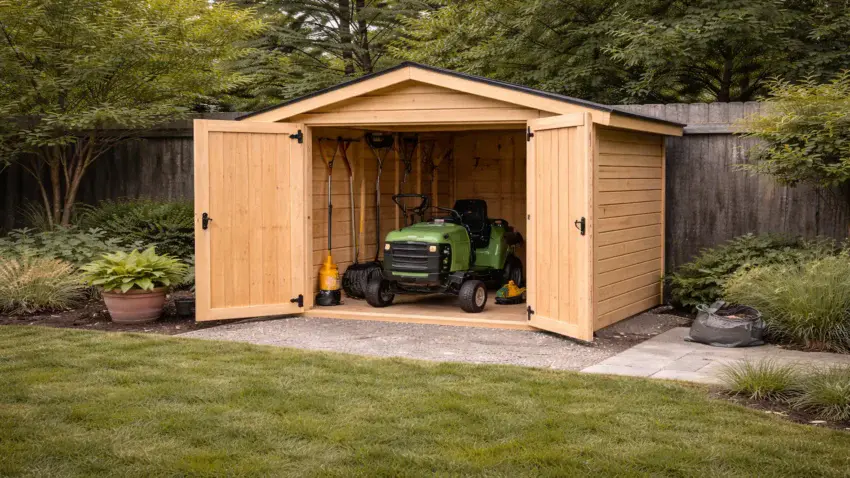
Once you start dealing with larger items like lawn mowers, wheelbarrows, and spreaders,
standard tool sheds stop making sense.
Backyard utility shed plans for lawn and garden equipment are designed for
bulkier gear that needs floor space, clearance, and easy movement.
These sheds focus less on wall organization and more on access, durability,
and practical layout — so equipment goes in and out without frustration.
This guide is part of my backyard utility shed plans collection,
where I focus on multi-purpose storage designs built for small outdoor spaces.
Why Lawn & Garden Equipment Needs a Utility Shed
Larger equipment brings different storage challenges.
Utility shed plans are built to:
-
Handle heavier loads
-
Provide wide, unobstructed floor space
-
Allow equipment to roll in and out easily
-
Reduce lifting and awkward maneuvering
This makes them ideal for homeowners who maintain their own lawns and gardens.
Equipment These Sheds Are Designed For
Backyard utility sheds typically store:
-
Push mowers or small riding mowers
-
Wheelbarrows and carts
-
Spreaders and lawn rollers
-
Trimmers, edgers, and blowers
-
Fuel containers and seasonal gear
The layout prioritizes floor access first, then secondary wall storage.
Shed Sizes That Work for Equipment Storage
Utility sheds need more width and depth than tool sheds.
Common equipment-friendly sizes include:
-
8×8 – Minimum workable footprint
-
8×10 – Comfortable for most push equipment
-
10×10 – Balanced size for mixed storage
-
8×12 – Extra depth without overwhelming the yard
Door width matters just as much as total square footage.
Door and Access Features That Matter
Equipment sheds live or die by access design.
Good plans include:
-
Wide single doors or double doors
-
Low or flush thresholds
-
Straight entry paths (no tight turns)
-
Door placement aligned with yard flow
These features prevent scraping, lifting, and frustration.
Flooring and Foundations for Rolling Equipment
Utility shed floors need to handle weight and movement.
Most plans use:
-
Pressure-treated floor framing
-
Reinforced joist spacing
-
Plywood subfloors rated for load
-
Gravel or block foundations for stability
A solid floor keeps equipment stable and easy to maneuver.
Roof and Wall Design for Utility Use
Utility sheds benefit from:
-
Simple gable or shed-style roofs
-
Taller wall heights for equipment clearance
-
Minimal interior obstructions
-
Strong wall framing for future upgrades
The goal is flexibility—not decorative detail.
Who These Utility Shed Plans Are Best For
Backyard utility shed plans for lawn and garden equipment are ideal if you:
-
Store rolling or motorized equipment
-
Want floor space over wall organization
-
Maintain your own yard regularly
-
Need multi-purpose outdoor storage
They bridge the gap between tool sheds and larger outbuildings.
Where This Fits in the Utility Shed Lineup
This is the equipment-focused branch of utility sheds.
It pairs naturally with other utility designs that add workbench space, multi-use layouts,
or homeowner-friendly builds — covered throughout the rest of this section.
What’s Next
If you want a utility shed that does more than store equipment —
such as supporting light DIY work or seasonal projects —
the next step is exploring multi-purpose layouts.
Continue to my backyard utility shed plans guide to explore flexible designs built
for small outdoor spaces.
 Plan it. Grow it. Enjoy it!
 Helpful Resources for Small Greenhouse Success
Planning and maintaining a small greenhouse goes far beyond choosing the right size or layout.
Understanding common pitfalls, having the right tools on hand,
and setting things up correctly from the start can make a
noticeable difference in both plant health and long-term enjoyment.
If you’re continuing your small greenhouse journey,
these guides will help you move forward with confidence:
-
Common Small Greenhouse Mistakes to Avoid
Learn which sizing, layout, and airflow mistakes cause the most frustration for new growers —
and how to avoid them early. -
Essential Gardening Tools for Small Spaces
A practical breakdown of tools that make daily greenhouse tasks easier, cleaner,
and more efficient in compact environments. -
Small Greenhouse Setup Guide
Step-by-step guidance on positioning, airflow planning,
and layout decisions that set your greenhouse up for long-term success.
 Turn Your Shed Building Experience Into a Simple Online Income
Curious how this site was built?
 Click here to learn more about Wealthy Affiliate.
SmallGardenBox.com started as a simple project built around small-space gardening ideas and greenhouse setups — and it only grew once I learned how to properly build and structure a real website.
If you’ve ever thought about sharing your gardening knowledge, greenhouse experience,
or shed building tips,
the training at Wealthy Affiliate is what I personally used and recommend.
It walks you through building a website, creating helpful content,
and turning that knowledge into a long-term online asset.
