Ventilation in small greenhouses usually falls into two categories:
passive airflow and active airflow.
Both can work — but they behave very differently in compact spaces,
and choosing the wrong approach often creates more problems than it solves.
This page supports our main guide, Greenhouse Ventilation & Airflow for Small Spaces,
which explains how to move fresh air through compact greenhouses without
creating temperature swings or plant stress.
This page focuses on how passive and active ventilation differ at small scale,
and when each approach actually makes sense.
What Passive Ventilation Means in Small Greenhouses
Passive ventilation relies on natural air movement rather than powered equipment.
Common passive elements include:
-
Roof vents and side vents
-
Open doors or panels
-
Temperature-driven airflow (warm air rising, cool air entering)
In theory, passive ventilation is simple. In small greenhouses, however,
limited air volume and tight layouts often reduce its effectiveness.
Why Passive Ventilation Has Limits in Compact Spaces
Passive systems work best when there’s enough space for air to:
-
Enter
-
Move through the structure
-
Exit naturally
In small greenhouses, that airflow path is short and easily disrupted. Common issues include:
-
Air entering but not circulating
-
Heat dumping too quickly through open vents
-
Stagnant pockets forming away from openings
Passive ventilation can help, but it rarely provides consistent airflow on its own in tight footprints.
What Active Ventilation Looks Like at Small Scale
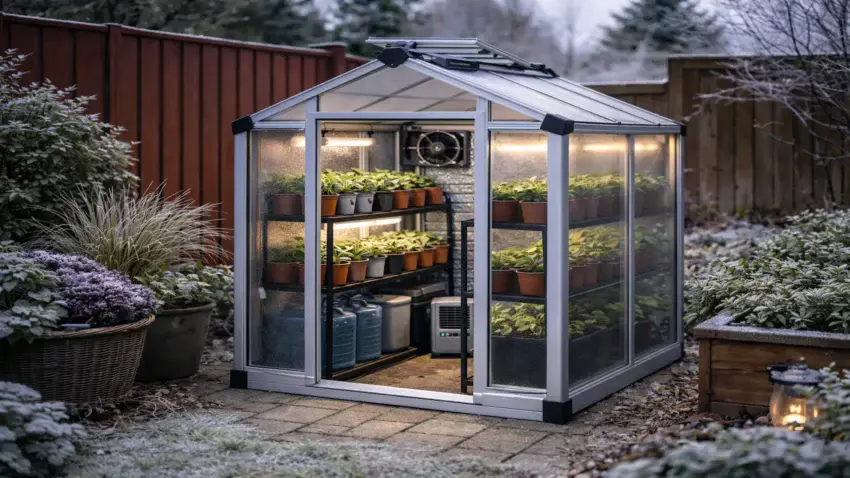
Active ventilation uses powered airflow, typically through:
-
Small circulation fans
-
Exhaust fans
-
Intake fans paired with vents
In compact greenhouses, active ventilation doesn’t need to be powerful —
it needs to be predictable.
A small fan moving air continuously often outperforms large fans that cycle on and off.
Why Active Ventilation Is Often More Reliable
In small spaces, active ventilation offers advantages passive systems can’t match:
-
Consistent air movement
-
Better humidity control
-
Reduced dead zones
-
Less reliance on outdoor wind conditions
Because airflow is forced, active systems are easier to fine-tune and
easier to pair with heating and temperature control.
When Passive Ventilation Still Makes Sense
Passive ventilation isn’t useless — it just has a narrower role in small greenhouses.
It works best:
-
During mild weather
-
As a supplement to active airflow
-
When paired with careful vent placement
Used alone, passive systems often fall short.
Used together with active airflow, they can reduce how hard fans need to work.
Avoiding Over-Ventilation in Small Greenhouses
One of the biggest mistakes in compact spaces is over-ventilating.
Too much airflow can:
-
Strip heat too quickly
-
Create temperature swings
-
Dry plants excessively
Small greenhouses benefit from steady, gentle air movement, not constant air exchange.
How Passive and Active Systems Work Together
The most effective small-greenhouse setups usually combine:
-
Passive openings for air exchange
-
Active fans for circulation and control
This hybrid approach allows airflow to be adjusted without relying entirely on
weather conditions or manual intervention.
How This Fits Into the Bigger Ventilation Plan
Understanding the difference between passive and active ventilation helps you
choose airflow strategies that actually work in compact spaces.
Our main guide on Greenhouse Ventilation & Airflow for Small Spaces shows how to combine vent placement, fan selection, and timing into a balanced airflow system that supports plant health without fighting temperature control.
Final Thoughts…
In small greenhouses, the best ventilation system isn’t the most complex —
it’s the most consistent.
Passive airflow alone often isn’t enough. Active airflow doesn’t need to be aggressive.
When both are scaled correctly and used together,
airflow becomes predictable instead of problematic.
From here, the next step is understanding
where airflow should move inside a small greenhouse, not just how it’s created.
 Plan it. Grow it. Enjoy it!
 Helpful Resources for Small Greenhouse Success
Planning and maintaining a small greenhouse goes far beyond choosing the right size or layout. Understanding common pitfalls, having the right tools on hand,
and setting things up correctly from the start can make a noticeable difference in both plant health
and long-term enjoyment.
If you’re continuing your small greenhouse journey,
these guides will help you move forward with confidence:
-
Common Small Greenhouse Mistakes to Avoid
Learn which sizing, layout, and airflow mistakes cause the most frustration for new growers —
and how to avoid them early. -
Essential Gardening Tools for Small Spaces
A practical breakdown of tools that make daily greenhouse tasks easier,
cleaner, and more efficient in compact environments. -
Small Greenhouse Setup Guide
Step-by-step guidance on positioning, airflow planning,
and layout decisions that set your greenhouse up for long-term success.
 Turn Your Gardening Knowledge Into a Simple Online Income
Curious how this site was built?
 Click here to learn more about Wealthy Affiliate.
SmallGardenBox.com started as a simple project built around small-space gardening ideas
and greenhouse setups — and it only grew once I learned how to properly build
and structure a real website.
If you’ve ever thought about sharing your gardening knowledge, greenhouse experience,
or small-space growing tips online, the training at Wealthy Affiliate is what I personally used
and recommend.
It walks you through building a website, creating helpful content,
and turning that knowledge into a long-term online asset.
