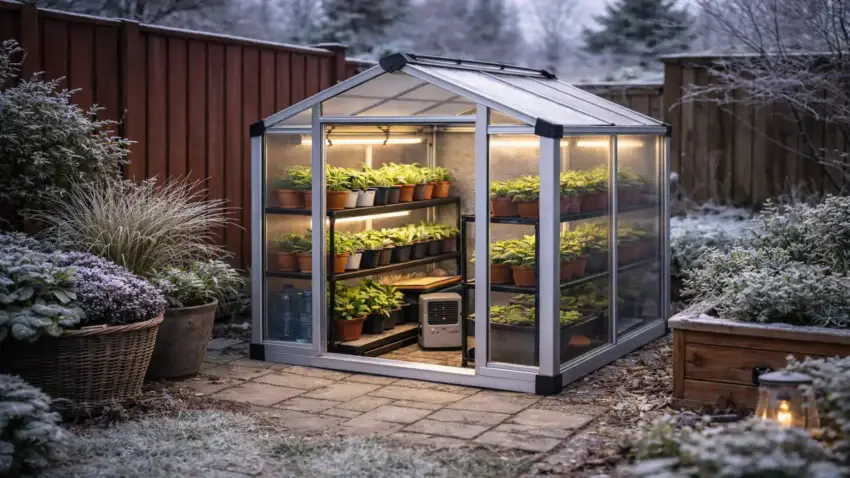
Choosing a heater for a compact greenhouse isn’t about finding the strongest option —
it’s about selecting heating methods that match small-space behavior.
Before diving into specific approaches, it helps to understand why small structures heat differently,
which we cover in our main guide on Greenhouse Heating for Small Spaces.
This page focuses on heating methods that actually work in small greenhouses
without creating temperature spikes, safety issues, or wasted energy.
This page supports our main guide, Greenhouse Heating for Small Spaces,
which explains how to safely and effectively manage temperature in compact greenhouse environments.
Why Heater Choice Matters More in Small Greenhouses
In a compact greenhouse, every heating decision has amplified effects.
-
Heat builds faster
-
Mistakes show up quicker
-
Oversized heaters cause more harm than good
That’s why “recommended heater size” charts for larger greenhouses often fail
when applied to balcony, patio, or mini backyard setups.
The goal here isn’t maximum warmth — it’s stable, controlled temperature support.
Low-Watt Electric Greenhouse Heaters
For most small greenhouses, low-watt electric heaters are the most predictable and manageable option.
Why they work well
-
Designed for limited air volume
-
Easier to pair with thermostats
-
Lower risk of overheating
-
Clean, dry heat without combustion risks
In compact spaces, a modest heater that cycles gently is far more effective than a
powerful unit that constantly overshoots the target temperature.
Best use case:
Small backyard greenhouses, patio builds, enclosed side-yard structures
Heat Mats and Root-Zone Heating
One of the most overlooked strategies in small greenhouses is root-zone heating.
Instead of warming all the air, heat mats:
-
Warm soil directly
-
Reduce stress on seedlings
-
Lower overall air-temperature requirements
This approach works especially well in tight spaces where air temperatures fluctuate quickly
but soil temperatures can remain more stable.
Best use case:
Seed starting, young plants, compact shelving setups
Passive Heat Support (Not a Standalone Solution)
Passive heat strategies don’t replace active heating — but in small greenhouses,
they multiply its effectiveness.
Common passive helpers include:
-
Thermal mass (water containers, stone, masonry)
-
Improved insulation and draft sealing
-
Strategic placement to maximize winter sun
In compact spaces, even small passive upgrades noticeably slow nighttime heat loss,
reducing how often active heaters need to run.
Best use case:
Mild to moderate cold climates, energy-conscious setups
Why Propane and High-Output Heaters Often Fail
High-output heaters and fuel-burning options are rarely a good match for small greenhouses.
Common problems include:
-
Rapid overheating
-
Poor temperature control
-
Excess moisture buildup
-
Ventilation conflicts in tight spaces
These systems are designed for large air volumes,
not compact enclosures where conditions change minute by minute.
For small greenhouses, control beats power every time.
Matching Heating Method to Greenhouse Size
A good rule of thumb for small spaces:
-
Start with insulation and heat retention
-
Add low-output, controllable heat
-
Supplement with root-zone warming when needed
-
Avoid systems built for larger structures
When heating methods scale appropriately,
plants experience fewer stress cycles and energy use stays reasonable.
How This Fits Into the Bigger Heating Plan
This page outlines what heating methods work best at a small scale.
Our main guide on Greenhouse Heating for Small Spaces ties these options together
and shows how to combine them into a balanced, plant-friendly heating strategy.
Final Thoughts…
In small greenhouses, effective heating is about restraint.
The best systems are often the least dramatic — quiet heaters, steady thermostats,
and targeted warmth where plants need it most.
When heating methods are chosen with scale in mind,
small greenhouses stay productive without constant adjustment or risk.
 Plan it. Grow it. Enjoy it!
 Helpful Resources for Small Greenhouse Success
Planning and maintaining a small greenhouse goes far beyond choosing the right size or layout. Understanding common pitfalls, having the right tools on hand,
and setting things up correctly from the start can make a noticeable difference in both plant health
and long-term enjoyment.
If you’re continuing your small greenhouse journey,
these guides will help you move forward with confidence:
-
Common Small Greenhouse Mistakes to Avoid
Learn which sizing, layout, and airflow mistakes cause the most frustration for new growers —
and how to avoid them early. -
Essential Gardening Tools for Small Spaces
A practical breakdown of tools that make daily greenhouse tasks easier,
cleaner, and more efficient in compact environments. -
Small Greenhouse Setup Guide
Step-by-step guidance on positioning, airflow planning,
and layout decisions that set your greenhouse up for long-term success.
 Turn Your Gardening Knowledge Into a Simple Online Income
Curious how this site was built?
 Click here to learn more about Wealthy Affiliate.
SmallGardenBox.com started as a simple project built around small-space gardening ideas
and greenhouse setups — and it only grew once I learned how to properly build
and structure a real website.
If you’ve ever thought about sharing your gardening knowledge, greenhouse experience,
or small-space growing tips online, the training at Wealthy Affiliate is what I personally used
and recommend.
It walks you through building a website, creating helpful content,
and turning that knowledge into a long-term online asset.
