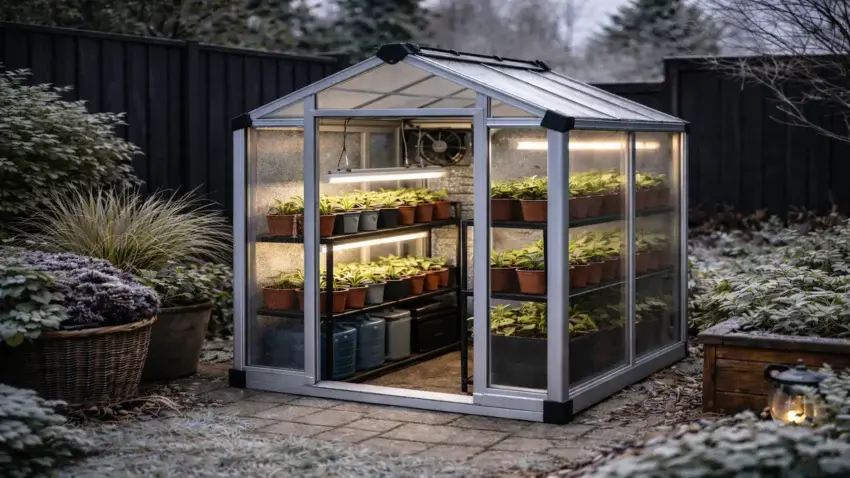
Once the right grow light type is chosen, placement and mounting height
determine whether that light actually helps plants or creates new problems. In small greenhouses, distance matters more than power, and poor placement can waste light, overheat foliage, or leave lower plants underlit.
This page supports our main guide, Lighting & Grow Lights for Small Greenhouses,
which explains how to add effective supplemental lighting in
compact greenhouse spaces without overwhelming plants or structure.
This page focuses on where to place grow lights and how high to mount them
so light is distributed evenly in small greenhouse environments.
Why Placement Matters More Than Output in Small Spaces
In compact greenhouses, plants sit close to light sources.
That means:
-
Small height changes dramatically affect intensity
-
Light falloff happens quickly across shelves
-
Poor angles create bright spots and dark corners
A modest light placed correctly often outperforms a stronger light placed poorly.
Typical Grow Light Placement Zones
Most small greenhouses benefit from dividing lighting into zones.
Common zones include:
-
Top shelves: closest to glazing, often need less supplemental light
-
Middle shelves: benefit most from direct overhead lighting
-
Lower levels: usually require targeted support due to shading
Treating each zone separately prevents overlighting upper plants while starving lower ones.
How High to Mount Grow Lights
Mounting height depends on light type and plant sensitivity, but general principles apply.
In small greenhouses:
-
Lights should be close enough to avoid spill and waste
-
Far enough to prevent leaf stress or heat buildup
-
Adjustable whenever possible
If plants show bleaching, curling, or excessive drying, lights are usually too close.
If growth stretches upward, lights are likely too far away.
Avoiding Hot Spots and Shadow Zones
Because space is tight, poor placement creates problems fast.
Common mistakes include:
-
Lights centered too narrowly over shelves
-
Fixtures mounted too close to walls
-
Light beams overlapping unevenly
The goal is coverage, not intensity.
Even light across the plant canopy matters more than peak brightness in one spot.
Vertical Spacing and Shelf Considerations
Shelving multiplies light challenges.
In stacked layouts:
-
Upper shelves block natural and artificial light below
-
Lower shelves often need dedicated fixtures
-
Light angle becomes as important as height
Slim fixtures and under-shelf mounting often work better than overhead-only solutions
in multi-level setups.
Adjusting Placement as Plants Grow
Plants don’t stay the same height — lighting shouldn’t either.
Good small-greenhouse lighting setups allow:
-
Easy height adjustments
-
Fixture repositioning between seasons
-
Light redistribution as plant density changes
Rigid mounting leads to constant compromise.
Flexible placement keeps lighting effective as conditions change.
How This Fits Into the Bigger Lighting Plan
Light placement and height turn grow lights from a concept into a working system.
Once light type is chosen and natural light gaps are identified,
placement determines how efficiently that light is used.
Our main guide on Lighting & Grow Lights for Small Greenhouses ties light behavior,
supplementation decisions, light types, and placement together into a balanced lighting
approach designed specifically for compact greenhouse spaces.
Final Thoughts…
In small greenhouses, successful lighting isn’t about brightness —
it’s about distance and distribution.
Lights placed thoughtfully, mounted at appropriate heights,
and adjusted as plants grow provide better results with less stress and less energy use.
When placement is dialed in, even simple lighting setups perform reliably.
That’s what turns supplemental lighting into a tool instead of a constant adjustment problem.
 Plan it. Grow it. Enjoy it!
 Helpful Resources for Small Greenhouse Success
Planning and maintaining a small greenhouse goes far beyond choosing the right size or layout. Understanding common pitfalls, having the right tools on hand,
and setting things up correctly from the start can make a noticeable difference in both plant health
and long-term enjoyment.
If you’re continuing your small greenhouse journey,
these guides will help you move forward with confidence:
-
Common Small Greenhouse Mistakes to Avoid
Learn which sizing, layout, and airflow mistakes cause the most frustration for new growers —
and how to avoid them early. -
Essential Gardening Tools for Small Spaces
A practical breakdown of tools that make daily greenhouse tasks easier,
cleaner, and more efficient in compact environments. -
Small Greenhouse Setup Guide
Step-by-step guidance on positioning, airflow planning,
and layout decisions that set your greenhouse up for long-term success.
 Turn Your Gardening Knowledge Into a Simple Online Income
Curious how this site was built?
 Click here to learn more about Wealthy Affiliate.
SmallGardenBox.com started as a simple project built around small-space gardening ideas
and greenhouse setups — and it only grew once I learned how to properly build
and structure a real website.
If you’ve ever thought about sharing your gardening knowledge, greenhouse experience,
or small-space growing tips online, the training at Wealthy Affiliate is what I personally used
and recommend.
It walks you through building a website, creating helpful content,
and turning that knowledge into a long-term online asset.
