
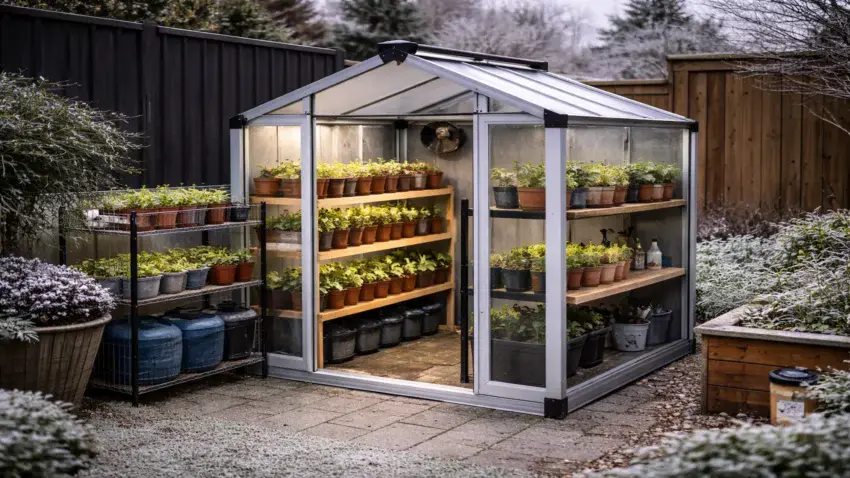
In small greenhouses, shelving does more than hold plants —
it controls light access, airflow, temperature balance, and how usable the space feels day to day.
The wrong shelving choice can block light, trap humidity, and make routine tasks frustrating.
The right shelving makes everything else work better.
This page supports our main guide, Shelving, Layout & Space Optimization for Small Greenhouses,
which explains how to organize shelves and walkways to improve airflow, light distribution,
and daily usability in compact greenhouse spaces.
This page focuses on shelving types that work best in small greenhouses,
and why scale and openness matter more than raw strength or storage capacity.
Why Shelving Choice Matters More Than Shelf Count
In compact greenhouses, every vertical surface affects the environment.
Poor shelving choices often:
-
Block light from lower plants
-
Restrict airflow behind and beneath shelves
-
Create tight working angles that discourage maintenance
Adding more shelves isn’t always the answer.
Choosing the right shelves usually matters more than adding extra levels.
Wire Shelving: The Most Flexible Option
Wire shelving is one of the most effective choices for small greenhouses.
It works well because it:
-
Allows light to pass through to lower levels
-
Promotes airflow around pots and trays
-
Adjusts easily as plant heights change
-
Keeps the space visually open
For mixed plant setups or changing seasons,
wire shelving adapts better than most alternatives.
Slatted Shelving: A Balanced Middle Ground
Slatted shelves offer more support than wire while still allowing some airflow and light penetration.
They’re useful when:
-
Heavier pots are involved
-
Moderate airflow is acceptable
-
Shelf spacing is fixed but predictable
In small greenhouses, slatted shelving should be spaced carefully to avoid excessive shading below.
Solid Shelving: Use Sparingly
Solid shelves can work — but only in limited roles.
They’re best used:
-
Along north-facing walls
-
For storage rather than plant growth
-
Where light loss won’t affect plants
In tight spaces, solid shelving often creates dark, stagnant zones if used extensively.
Mobile and Modular Shelving Options
Flexibility is valuable in small greenhouses.
Rolling or modular shelves:
-
Allow layouts to change seasonally
-
Improve access for cleaning and maintenance
-
Make it easier to adjust airflow patterns
While not always necessary, mobile shelving can prevent long-term layout lock-in.
Shelf Depth and Height Considerations
In compact greenhouses, shelf size matters as much as shelf type.
Best practices include:
-
Shallow shelves to prevent rear shading
-
Adjustable heights to match plant growth
-
Avoiding floor-to-ceiling shelving runs
Overbuilt shelving reduces usable space faster than most growers expect.
Matching Shelving to Plant Types
Different plants demand different shelf behavior.
For example:
-
Seedlings benefit from open, adjustable shelving
-
Larger plants may need fewer, stronger shelves
-
Mixed plant setups require compromise and flexibility
Shelving that works for one crop may struggle when plant selection changes.
How This Fits Into the Bigger Layout Plan
Shelving is the framework that layout decisions attach to.
Once shelving type is chosen correctly, spacing, walkways, airflow paths,
and lighting placement become easier to plan.
Our main guide on Shelving, Layout & Space Optimization for Small Greenhouses
shows how shelving choice integrates with overall layout strategy to keep
compact spaces productive and manageable.
Final Thoughts…
In small greenhouses, shelving should support the environment, not dominate it.
Open designs, adjustable heights, and moderate depth help light
and air reach plants evenly while keeping the space easy to work in.
When shelving fits the scale of the greenhouse, everything else becomes simpler.
Next, the focus shifts to how far apart shelves and plants should be spaced
to maintain airflow and accessibility in small greenhouse layouts.
 Plan it. Grow it. Enjoy it!
 Helpful Resources for Small Greenhouse Success
Planning and maintaining a small greenhouse goes far beyond choosing the right size or layout. Understanding common pitfalls, having the right tools on hand,
and setting things up correctly from the start can make a noticeable difference in both plant health
and long-term enjoyment.
If you’re continuing your small greenhouse journey,
these guides will help you move forward with confidence:
-
Common Small Greenhouse Mistakes to Avoid
Learn which sizing, layout, and airflow mistakes cause the most frustration for new growers —
and how to avoid them early. -
Essential Gardening Tools for Small Spaces
A practical breakdown of tools that make daily greenhouse tasks easier,
cleaner, and more efficient in compact environments. -
Small Greenhouse Setup Guide
Step-by-step guidance on positioning, airflow planning,
and layout decisions that set your greenhouse up for long-term success.
 Turn Your Gardening Knowledge Into a Simple Online Income
Curious how this site was built?
 Click here to learn more about Wealthy Affiliate.
SmallGardenBox.com started as a simple project built around small-space gardening ideas
and greenhouse setups — and it only grew once I learned how to properly build
and structure a real website.
If you’ve ever thought about sharing your gardening knowledge, greenhouse experience,
or small-space growing tips online, the training at Wealthy Affiliate is what I personally used
and recommend.
It walks you through building a website, creating helpful content,
and turning that knowledge into a long-term online asset.
